
The Truth Machine
Prediction markets are how we'll figure out what's true

I’m doing my senior computer science thesis on prediction markets, specifically on their oracles. Maybe I’ll get into my specific thesis idea in a different article, but I wanted to spend time talking about prediction markets themselves. They’ve been taking the world by storm, and honestly, I’m pretty obsessed with them.
So here’s what got me hooked.
A few weeks before the 2024 presidential election, traditional pollsters were calling it a coin flip. Pundits hedged with “too close to call” and “within the margin of error.” The smart money was supposedly on uncertainty.
Except it wasn’t.
On Polymarket, a crypto-based prediction market, Trump shares were trading at 60 cents. Not 50. Sixty. By midnight on election night, hours before any major network called the race, those shares hit 95 cents. The market knew.
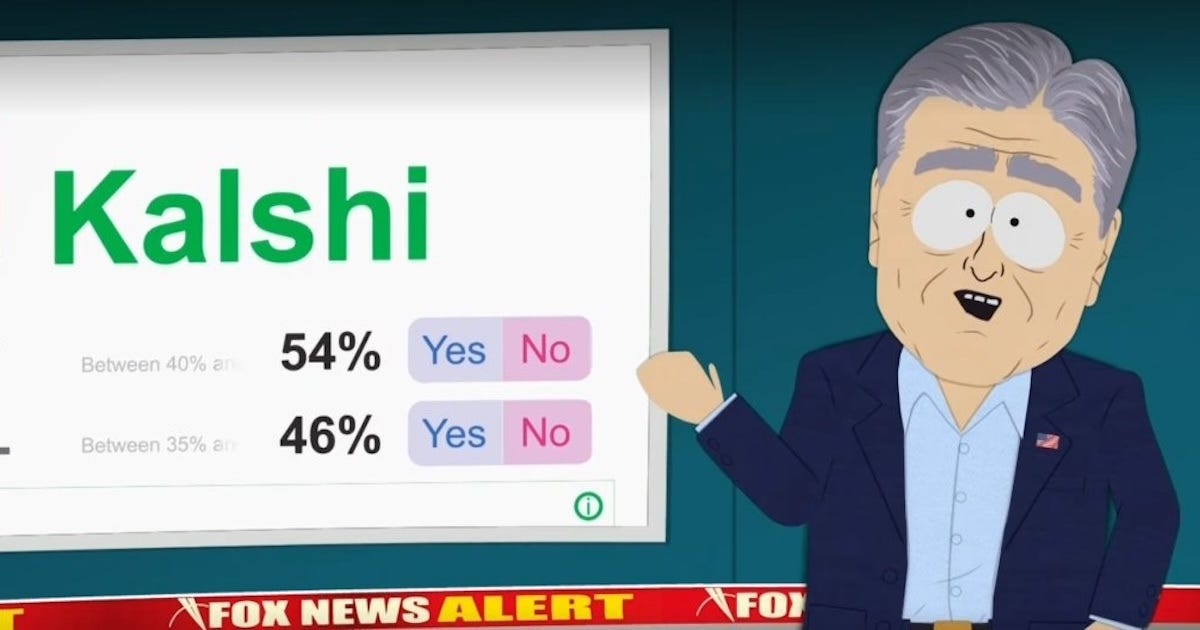
Figure 1: Kalshi (a prediction market) shown in a south park episode. So cool!
A Stock Market for Reality
The concept is pretty simple. Prediction markets let you buy and sell shares in future events. Think the Fed will cut rates next month? Buy YES shares. If you’re right, each share pays out a dollar. Wrong, and you lose your stake.
The price of a share represents the crowd’s belief about probability. Shares at 65 cents mean the market thinks there’s a 65% chance the event happens. It’s basically a stock market for opinions, except the opinions are about what will actually happen rather than company valuations.
Here’s how it works in practice. A market asks: “Will the Federal Reserve cut interest rates this month?” YES shares trade at 62 cents. You’ve looked at the economic data and think there’s an 80% chance of a cut. So you buy 500 shares for $310. If the Fed cuts, you get $500 back. If not, you lose your $310.
That financial stake is the whole point.
Why It Works
The intellectual foundation goes back to Friedrich Hayek’s 1945 essay “The Use of Knowledge in Society.” His argument was that knowledge is dispersed. No expert, no matter how credentialed, has all the relevant information about anything. A factory worker in Ohio notices declining orders. A lobbyist hears something about regulatory changes. An analyst spots weird patterns in the data. Each person holds a piece of the truth.
Markets, Hayek argued, work like a telecommunications network. They pull millions of individual judgments into a single price signal. Stock markets do this for company values. Prediction markets do it for future events.
The key difference from polls: prediction markets don’t ask what you want to happen. They ask what you think will happen. And when your money is on the line, you think harder about whether you’re right.
Professor Eric Zitzewitz of Dartmouth put it this way: “There’s no virtue-signaling in an anonymous market when you’re betting.”
This creates self-selection. People with real insight show up because they can make money. People without insight either lose money and leave or never participate. The market filters out noise and surfaces good information.
The Track Record
This isn’t just theory.
The Iowa Electronic Markets beat professional polling organizations 74% of the time across U.S. presidential elections from 1988 to 2004. At Hewlett-Packard, internal prediction markets outperformed official company forecasts 75% of the time when predicting printer sales. Intel, Boeing, General Electric, and Eli Lilly have all used internal markets for product timelines and drug development.
And then 2024. While pollsters were stuck in “statistical tie” territory, prediction markets were absorbing information the polls couldn’t capture. Some traders commissioned their own private polling. Others had on-the-ground intel from swing states. Others were just better at reading public data.
The market aggregated all of it. The result beat billions of dollars worth of polling infrastructure.
Vitalik Buterin called this a breakthrough for what he terms “info finance.” The idea that financial mechanisms can produce better information than traditional institutions. Not by replacing experts, but by creating systems where expertise shows up through action rather than credentials.
The Current Landscape
The growth has been wild. Prediction market volume went from $9 billion in 2024 to over $44 billion in 2025. Polymarket processed over $3.6 billion on the presidential election alone. Kalshi, the regulated U.S. platform, now does over a billion dollars weekly.
But what’s more interesting is who’s getting involved. ICE, the company that owns the New York Stock Exchange, put $2 billion into Polymarket at roughly a $9 billion valuation. Kalshi hit $11 billion after its December 2025 funding round. DraftKings, FanDuel, Robinhood, Coinbase have all launched or announced prediction market products.
Media followed. CNN and CNBC signed multi-year partnerships for live prediction market data. Yahoo Finance partnered with Polymarket. X made them the official prediction market partner. Google Finance now shows prediction market probabilities next to stock data. Coinbase and Kalshi partnered to integrate prediction markets into the coinbase App
These companies aren’t betting on a gambling product. They’re betting on information infrastructure.
Beyond Elections
The applications go way beyond politics, which is what makes this so interesting to me.
Take the replication crisis in science. Published studies fail to reproduce all the time, wasting an estimated $28 billion annually chasing false findings. Prediction markets have shown 73% accuracy in identifying which studies will replicate, beating expert surveys at way lower cost. Instead of waiting years for replication attempts, researchers could get early signals about which findings to trust.
Or national security. The U.S. Army Military Intelligence Professional Bulletin now officially recognizes prediction markets as intelligence tools. Their assessment notes the “dynamic, real-time nature” of markets versus “the slower, often bureaucratic processes of traditional intelligence collection.” Markets have been used to forecast geopolitical conflicts, political transitions, sanctions impacts.
The pattern holds. Wherever you have dispersed information and need accurate forecasting, prediction markets tend to beat alternatives. Not because they’re magic. Because they solve a hard problem: how do you get people to say what they actually believe instead of what sounds good?
Why Blockchain
Many of the biggest prediction markets such as polymarketrun on crypto.
Blockchain lets you do things that would be hard otherwise. Anyone can audit trades on a public ledger. Smart contracts pay out automatically when events resolve, so you don’t have to trust a central operator. Markets run 24/7 and respond to news in real time. And anyone with an internet connection and a crypto wallet can participate.
Polymarket uses something called UMA’s Optimistic Oracle for resolution. Users propose outcomes and stake crypto as collateral. If someone disputes it, token holders vote. It’s a decentralized way to determine what actually happened, which matters a lot when you’re building markets about contested events.
Compare this to a sportsbook. There, you’re betting against the house. The house sets the odds. The house profits no matter what. In a prediction market, you’re trading with other participants. Every YES share has a corresponding NO share. Together they equal a dollar. Zero-sum between participants, not rigged toward an operator.
This matters for accuracy. Without a house edge to overcome, informed traders can profit from small mispricings. That makes prices more accurate.
Where This Goes
I don’t think prediction markets will stay limited to simple binary outcomes. “Will X happen by Y date?” is useful, but it’s only one type of question. What about more subjective, continuous things?
A company called Noise just raised $7.1 million from Paradigm to build what they call “attention markets.” Instead of betting on whether something happens, you bet on whether a trend, brand, or narrative will stay culturally relevant over time. It’s like a stock market for attention. The price doesn’t resolve to yes or no; it moves continuously based on how the world’s interest shifts.
This feels like where things are headed. Not just “did this happen” but “how much does this matter.”
Vitalik has been thinking along similar lines. He talks about using market mechanisms to build better versions of social media, science, news, governance. Instead of centralized fact-checkers or credentialed experts, you’d have systems where anyone can contribute to collective knowledge, with financial incentives that reward getting things right.
Robin Hanson, a leading economist inprediction market theory, goes further. He’s proposed “futarchy,” where organizations make decisions based on what markets predict about outcomes. A company defines success as revenue growth, then lets prediction markets evaluate whether a given decision helps or hurts. You separate decision-making from persuasion. You don’t convince anyone your idea is good. You bet on it.
Whether any of this pans out, I don’t know. But the direction seems clear. Prediction markets are becoming infrastructure.
Why I Care
Shayne Coplan, Polymarket’s 27-year-old founder, puts it like this: “If something is being discussed in the news, if something is of importance, whether it’s geopolitically, macroeconomically, culturally, we want to have a Polymarket for it.”
He goes onto say: “It’s the most accurate thing we have as mankind right now, until someone else creates some sort of super crystal ball.”
That’s probably overselling it. Markets can be wrong. They can be gamed when liquidity is thin. They have biases like any human system. And there are real open questions: about liquidity, about oracle systems (which is literally what I’m writing my thesis on), about how regulators will treat these platforms.
But the core idea feels right to me. When institutional trust keeps declining, prediction markets offer something useful: a way to establish probabilistic truth that doesn’t depend on any authority saying so. The price is collective belief, updated in real time, filtered through incentives that reward being right and punish wishful thinking.
We’ve had stock markets for centuries, aggregating beliefs about company values. Commodity markets aggregating beliefs about supply and demand. What we haven’t had is scalable infrastructure for aggregating beliefs about the future.
Now we do. I think the implications are bigger than most people realize, and I’m excited to be working on a small piece of it.